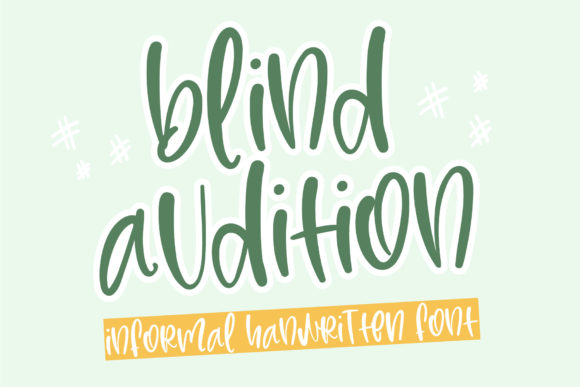
Blind Audition Script Font for Confident Brand Identity
I opened a fresh brand board last week—soft beige background, mood images of textured paper and warm light—and dropped in Blind Audition for the first time. Not as a placeholder. Not as a “maybe.” Right there, in the logo lockup draft for a new neighborhood ceramic studio, it just… landed. That’s rare. Most Script Handwritten fonts either feel too fussy or too floppy. Blind Audition is different: chic, but never stiff; trendy, but not fleeting; confident without shouting. It’s the kind of Fonts choice that makes clients pause mid-Zoom call and say, “Yes—that’s *her*.”
Blind Audition for Handmade Shop Logos and Packaging Labels
The ceramic studio sells wheel-thrown mugs, small-batch glazes, and workshop kits—all made locally, all with quiet intention. Their voice isn’t loud or flashy; it’s thoughtful, tactile, human. So I tested Blind Audition across three key touchpoints: the logo mark (paired with a clean, low-contrast sans serif for balance), the product label on a matte kraft sticker, and the header on their Instagram highlight covers. On the label, Blind Audition held its own at 14pt—no blurring, no awkward spacing. Its informal style kept things approachable, while the subtle contrast in stroke weight added just enough polish to feel intentional, not scribbled. As a Script Handwritten font, it doesn’t try to mimic pen-on-paper imperfection. Instead, it offers rhythm, flow, and a relaxed confidence that reads as authentic—not staged.
Blind Audition for Social Media Graphics and Website Headers
I built a set of Instagram story templates using Blind Audition for headlines only—never body text. Why? Because Blind Audition shines brightest as a display font. Its casual vibe works beautifully for short-form impact: “New Glaze Drop,” “Workshop Starts June 12,” “Handmade in Portland.” I paired it with a warm, neutral serif for captions (think: a soft-textured Garamond variant), and the contrast felt grounded, editorial, and quietly luxurious. On the website hero section, Blind Audition scaled cleanly up to 64px—no jagged edges, no collapsed counters. The font’s versatility meant it didn’t need heavy kerning adjustments or manual tracking tweaks across breakpoints. That’s a real-time saver when you’re juggling client revisions and launch deadlines.
Blind Audition for Wedding Invitations and Elegant Branding
A friend asked me to help refresh her stationery suite for an intimate garden wedding—and yes, I reached for Blind Audition. Not for the full invitation copy (too delicate for long reading), but for the couple’s names, the date line, and the RSVP card header. Its informal style softened the formality of traditional wedding typography without veering into cutesy territory. Paired with a fine hairline serif and plenty of negative space, Blind Audition brought warmth and personality to otherwise minimalist layouts. As a Script Handwritten option, it avoids the overused “bouncy script” trope—it’s smoother, more refined, and carries a sense of ease that feels earned, not applied.
Blind Audition for Business Cards and Printed Marketing Materials
I printed three versions of the ceramic studio’s business card: one with Blind Audition as the sole typeface (too much), one with it only on the tagline (“Made by hand, meant to hold”), and one with tight pairing—Blind Audition for the name + a crisp geometric sans for contact details. The third version won. Why? Because Blind Audition commands attention, but it needs breathing room. On uncoated stock, its casual vibe deepened—ink slightly feathered at the terminals, reinforcing tactility. That subtle texture reinforced the brand’s handmade ethos better than any photo could. As a commercial font, Blind Audition includes standard OpenType features: ligatures, stylistic alternates, and extended Latin support—enough to handle names, locations, and basic punctuation without fallbacks.
Blind Audition for Editorial Design and Creative Studio Branding
I used Blind Audition in a zine layout for a local print collective—specifically for pull quotes and section dividers. Its rhythm guided the eye without competing with photography or illustration. What surprised me was how well it worked alongside tight, structured grids. You’d expect a script font to fight order—but Blind Audition’s consistent x-height and open counters created visual harmony, not chaos. For creative studios building their own identity, this Script Handwritten font delivers personality without sacrificing professionalism. It says, “We’re skilled, we’re human, and we don’t take ourselves too seriously”—all in one wordmark.
How to Test Blind Audition Before Committing to a Full Brand System
Before locking it in, I did three quick checks: First, I typed the client’s full name, address, and tagline in Blind Audition at three sizes (12pt, 24pt, 48pt) across two backgrounds (white and warm off-white). Second, I exported a PDF and zoomed to 400%—no pixelation, no inconsistent joins. Third, I pasted it into a Figma auto-layout frame with dynamic resizing to confirm spacing held across widths. If your workflow includes web use, test it in a live browser with @font-face loading—Blind Audition renders cleanly in modern browsers, especially when served as WOFF2.
Font Pairing Tips for Blind Audition in Real Client Projects
Blind Audition pairs best with typefaces that offer contrast—not competition. Try it with a sturdy, slightly condensed sans (like Poppins or Inter) for logos and digital interfaces. For print-heavy brands, lean into a warm serif with gentle bracketing (e.g., Lora or Playfair Display). Avoid other script fonts unless they’re dramatically different in weight and tempo—Blind Audition holds its own, so it doesn’t need backup singers. And skip ultra-thin or ultra-bold companions; its confidence comes from balance, not bravado.
If you’re choosing Fonts for a brand that values authenticity, craftsmanship, and understated elegance—Blind Audition isn’t just another Script Handwritten option. It’s the quiet, capable collaborator who shows up ready, listens carefully, and elevates everything it touches.